Monday, June 30, 2008

Accessing Sysinternals Tools Has Never Been Easiser

windows_sysinternals Do you know the Sysinternals tools?

You probably do if you're an IT pro or a developer. For those who don't, it's a series of free utilities written by Mark Russinovich that are essential to manage, troubleshoot and diagnose your Windows systems and applications. I even need one of the Sysinternals tools for my classes: ZoomIt allows you to zoom and draw on the screen.

Microsoft acquired Sysinternals some time ago and since then the tools have been available, always for free of course, from the TechNet website. I, like many others, downloaded the whole suite and keep it in USB drives and my "Utils" folder. Even though the website's fine to learn more about each of the individual tools, it's not very practical when it comes to downloading and keeping them up to date.

Fortunately, the Sysinternals Team had the brilliant idea of actually sharing these files like you probably share your files on your home or office network, allowing you to run the tools from any computer connected to the Internet without having to navigate to a webpage, download and extract them. All you have to do is visit http://live.sysinternals.com/, which is simply a website with "Directory browsing" on or, even better, use the direct UNC link (\\live.sysinternals.com\Tools\) and run the tools directly. You'll probably want PowerShell installed for command line tools then, but those are the exception and all of the Windows apps will execute fine.

Sunday, June 29, 2008

Will Your Website Pass a Google Review?

Welcome to GoogleNet!

Hitwise recently mentioned that Google controls over 1/3 of UK web traffic.
Upstream uk internet traffic from google properties to other websites in the UK 2007 2008  chart.png
With that much usage data, if you were Google, would you use usage data in your relevancy algorithms?

An Army of Google Search Editors

They could easily use algorithms to detect

  • sites that they send a lot of traffic to relative to its total traffic (comparing ratios between toolbar data and search traffic)
  • sites which have seen a rapid spike in traffic from Google
  • sites which people quickly bounce away from (and do not later return to)
  • sites which get a lot of traffic from Google but get few navigational queries

and flag anything out of the ordinary for human review. Marissa Mayer stated they have 10,000 reviewers.

Does Your Site Look Good to Google's Relevancy Algorithm?

As the web keeps getting richer and deeper, and Google increasingly uses human review for demoting spam, all the aesthetic things matter:

  • domain name
  • site design
  • content formatting
  • branding and public relations

As search evolves so too will spam. Some spam sites will LOOK and FEEL better than most non-spam sites. And so the remote quality raters will be given more data to look at - perhaps eventually even a sample of backlinks or other related data.

False positives will occur - sites and careers built around Google without proper support stilts will crumble. Unless your site is of social significance (you are a big corporation, a non-profit organization, a government institution, an educational institution, a top blogger, an official Google partner, or Youtube/Google house content) then part of the optimization process revolves around not only creating sites that pass a hand review, but also trying to create sites that do not get flagged for review - especially if you are a thin affiliate site.

How do you not get flagged for review?

  • Build enough quality signals and direct traffic that your site looks like a real part of the web.
  • Build something people keep coming back to.
  • Do not make drastic changes to your site unless you are comfortable with it going under review.

How do you pass a review?

Short term I think the aesthetic things matter a lot. Longer term it is best if your site satisfies a few criteria

  • exclusive content that people value and keep coming back to (Google loses if they remove the best content from their index)
  • a brand that people care about and search for (Google looks dumb if they do not rank your site)
  • a meaningful and reliable traffic stream outside of Google (many quality signals may stem from this exposure, which will help keep your overall profile more organic)
  • you could cause public relations harm to Google and diminish their brand value in the eyes of thousands of people (removing your site has real opportunity cost)

Interesting SEO Links...

Roger Montti offers an insightful post on link building for new websites in 2008. If you have no traction you need to find a way to buy/beg/borrow/steal attention. Use that exposure to spread content that turns people on / gets them excited / evokes an emotional response / ties in with their worldview and identity...and watch the links flow like wine.

Debra mentioned how she sometimes has a hard time telling people that their sites will not get links because they are boring. I actually enjoy doing that because it forces them to take some ownership over their own success (it is hard to drag a company across the finish line if you are an outside consultant - much easier to win if they are at least willingly walking in the right direction).

The way I teach people that concept is I remove them for their ownership role. I ask "If you did not own this website why would you tell other people about and/or want to visit it at least once a week?" Once they can answer that question honestly with something that is inline with their market it means they have something worth marketing.

Steve, an all around great guy and moderator of our forums, made a great thread in our local website marketing forums worth checking out if you are a subscriber.

Predictably Irrational (great blog/book name) has a great post on the power of defaults in emotional transactions.

Google is hyping image pattern recognition technology they call VisualRank in the media. Either they are about to improve their image search or they want us to think they have the most sophisticated technology.

Here is a cool example of a nice image script that helps build links.

Brief synopsis of how AdWords has changed over the past couple years - killing off many of the bottom feeder advertisers. The long tail of SEO keeps growing, but PPC is a winner take most game...from head to tail.

Brent Csutoras shared his social media marketing presentation online.

Firewall Script - a tool used to help keep sites secure, mentioned by DaveN so it is probably pretty good.

SEW published an article about analyzing log files to audit redirects.

The Problogger Book is out. Congrats Darren and Chris. :)

Danny Sullivan has a nice recap of the Microsoft Yahoo fiasco. His forward to Philipp Lessen's new book - Google Apps Hacks is also a great read. Congrats to Philipp on finishing the book. :)

Breaking the Digg Code - free guide to getting the most out of Digg, though if you market an SEO site it is not worth marketing it on Digg. The average small-minded short-sighted Digg user thinks all SEO is spam - they are a reflection of the dumbest and loudest parts of society.

Use Intwition to see what posts from a site got the most Twitter links.

Why whitehats need to know blackhat SEO - as noted in the comments "nothing wrong with having a well rounded education."

Seed Keywords is a cool tool which allows you to pass a question on to friends or customers and ask them what they would search for to solve a particular problem.

Share your screen in 2 minutes with Microsoft SharedView

sharedview It took less than five minutes to go the Microsoft Connect website, download and install Microsoft SharedView to share my desktop with a friend.

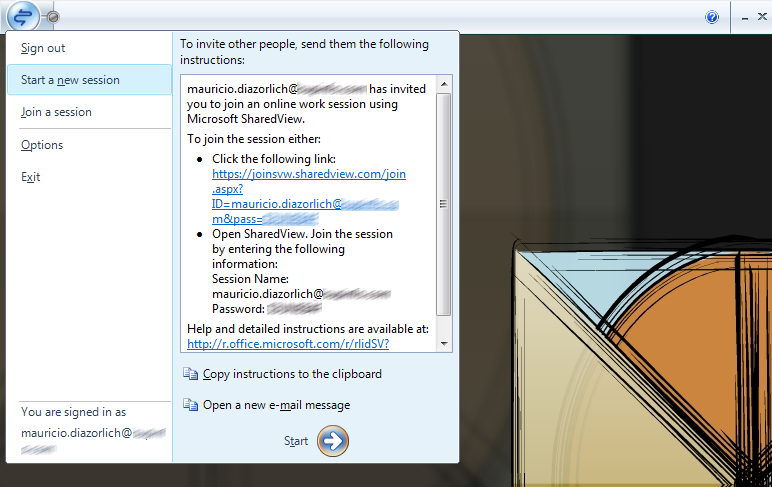
The installation is as simple as it can be. Once installed, you use a Live ID to sign into SharedView if you want to create a session. The session is created in two clicks and you are given clear instructions to invite people to join it (see screenshot). Guests to your session don't even need to sign in to join.

When members have joined your session you can share specific windows with them and even let them take control of your shared window. You can invite one or more people to present your work or to collaborate. It works fine over the Internet, even across firewalls.

Microsoft SharedView is still a beta (then again, what isn't these days?), but I really recommend that you give it a try. Free download available here.

Microsoft Proposes Another Yahoo! Partnership

Since buying out Yahoo! seemed too expensive, Microsoft is back again with another offer. Microsoft's Statement:

In light of developments since the withdrawal of the Microsoft proposal to acquire Yahoo! Inc., Microsoft announced that it is continuing to explore and pursue its alternatives to improve and expand its online services and advertising business. Microsoft is considering and has raised with Yahoo! an alternative that would involve a transaction with Yahoo! but not an acquisition of all of Yahoo! Microsoft is not proposing to make a new bid to acquire all of Yahoo! at this time, but reserves the right to reconsider that alternative depending on future developments and discussions that may take place with Yahoo! or discussions with shareholders of Yahoo! or Microsoft or with other third parties.

There of course can be no assurance that any transaction will result from these discussions.

From AllThingsD:

The software giant would not give details, but sources at both companies said it involved Microsoft buying Yahoo’s search business and the ad business related to text-based ads.

Kevin Johnson also posted an internal Microsoft memo on News.com.

Accessing Sysinternals Tools Has Never Been Easiser

windows_sysinternals Do you know the Sysinternals tools?

You probably do if you're an IT pro or a developer. For those who don't, it's a series of free utilities written by Mark Russinovich that are essential to manage, troubleshoot and diagnose your Windows systems and applications. I even need one of the Sysinternals tools for my classes: ZoomIt allows you to zoom and draw on the screen.

Microsoft acquired Sysinternals some time ago and since then the tools have been available, always for free of course, from the TechNet website. I, like many others, downloaded the whole suite and keep it in USB drives and my "Utils" folder. Even though the website's fine to learn more about each of the individual tools, it's not very practical when it comes to downloading and keeping them up to date.

Fortunately, the Sysinternals Team had the brilliant idea of actually sharing these files like you probably share your files on your home or office network, allowing you to run the tools from any computer connected to the Internet without having to navigate to a webpage, download and extract them. All you have to do is visit http://live.sysinternals.com/, which is simply a website with "Directory browsing" on or, even better, use the direct UNC link (\\live.sysinternals.com\Tools\) and run the tools directly. You'll probably want PowerShell installed for command line tools then, but those are the exception and all of the Windows apps will execute fine.

Improving Google Image Search Using Implicit PageRank

Image search engines have a very limited usefulness since it's difficult to accurately describe images in words and since search engines completely ignore the images, preferring to index anchor texts, file names or the text that surrounds images. "Search for apples, and they haven't actually somehow scanned the images itself to see if they contain pictures of apples," illustrates Danny Sullivan.

Image analysis didn't produce algorithms that could be used to process billions of images in a scalable way. "While progress has been made in automatic face detection in images, finding other objects such as mountains or tea pots, which are instantly recognizable to humans, has lagged," explains The New York Times.

An interesting paper [PDF] written by Yushi Jing and Google's Shumeet Baluja describes an algorithm similar to PageRank that uses the similarity between images as implicit votes. "We cast the image-ranking problem into the task of identifying authority nodes on an inferred visual similarity graph and propose an algorithm to analyze the visual link structure that can be created among a group of images. Through an iterative procedure based on the PageRank computation, a numerical weight is assigned to each image; this measures its relative importance to the other images being considered."

The paper, titled "PageRank for Product Image Search", assumes that people are more likely to go from an image to other similar images. "By treating images as web documents and their similarities as probabilistic visual hyperlinks, we estimate the likelihood of images visited by a user traversing through these visual-hyperlinks. Those with more estimated visits will be ranked higher than others." To determine the similarity between images, the paper suggests using different features depending on the type of images: local features, global features (color histogram, shape).

The system was tested on the most popular 2000 queries from Google Image Search on July 23rd, 2007, by applying the algorithm to the top 1000 results produced by Google's search engine and the results are promising: users found 83% less irrelevant images in the top 10 results, from 2.83 results in the current Google search engine to 0.47.

For example, a search for [Monet paintings] returned some of his famous paintings, but also "Monet Painting in His Garden at Argenteuil" by Renoir.


It may seem that this algorithm lacks the human element used to compute PageRank (links are actually created by people), but the two authors disagree. "First, by making the approach query dependent (by selecting the initial set of images from search engine answers), human knowledge, in terms of linking relevant images to webpages, is directly introduced into the system, since the links on the pages are used by Google for their current ranking. Second, we implicitly rely on the intelligence of crowds: the image similarity graph is generated based on the common features between images. Those images that capture the common themes from many of the other images are those that will have higher rank."

For now, this is just a research paper and it's not very clear if Google will actually use it to improve its search engine, but image search is certainly an area that will evolve dramatically in the future and will change the way we perceive search engines. Just imagine taking a picture of a dog with your mobile phone, uploading it to a search engine and instantly finding web pages that include similar pictures and information about the breed.

In 2006, Google acquired Neven Vision, a company specialized in image analysis, but the only new feature that could be connected to that acquisition is face detection in image search. Riya, another interesting company in this area, didn't manage to create a scalable system and decided to focus on a shopping search engine.

Will Your Website Pass a Google Review?

Welcome to GoogleNet!

Hitwise recently mentioned that Google controls over 1/3 of UK web traffic.
Upstream uk internet traffic from google properties to other websites in the UK 2007 2008  chart.png
With that much usage data, if you were Google, would you use usage data in your relevancy algorithms?

An Army of Google Search Editors

They could easily use algorithms to detect

  • sites that they send a lot of traffic to relative to its total traffic (comparing ratios between toolbar data and search traffic)
  • sites which have seen a rapid spike in traffic from Google
  • sites which people quickly bounce away from (and do not later return to)
  • sites which get a lot of traffic from Google but get few navigational queries

and flag anything out of the ordinary for human review. Marissa Mayer stated they have 10,000 reviewers.

Does Your Site Look Good to Google's Relevancy Algorithm?

As the web keeps getting richer and deeper, and Google increasingly uses human review for demoting spam, all the aesthetic things matter:

  • domain name
  • site design
  • content formatting
  • branding and public relations

As search evolves so too will spam. Some spam sites will LOOK and FEEL better than most non-spam sites. And so the remote quality raters will be given more data to look at - perhaps eventually even a sample of backlinks or other related data.

False positives will occur - sites and careers built around Google without proper support stilts will crumble. Unless your site is of social significance (you are a big corporation, a non-profit organization, a government institution, an educational institution, a top blogger, an official Google partner, or Youtube/Google house content) then part of the optimization process revolves around not only creating sites that pass a hand review, but also trying to create sites that do not get flagged for review - especially if you are a thin affiliate site.

How do you not get flagged for review?

  • Build enough quality signals and direct traffic that your site looks like a real part of the web.
  • Build something people keep coming back to.
  • Do not make drastic changes to your site unless you are comfortable with it going under review.

How do you pass a review?

Short term I think the aesthetic things matter a lot. Longer term it is best if your site satisfies a few criteria

  • exclusive content that people value and keep coming back to (Google loses if they remove the best content from their index)
  • a brand that people care about and search for (Google looks dumb if they do not rank your site)
  • a meaningful and reliable traffic stream outside of Google (many quality signals may stem from this exposure, which will help keep your overall profile more organic)
  • you could cause public relations harm to Google and diminish their brand value in the eyes of thousands of people (removing your site has real opportunity cost)

Interesting SEO Links...

Roger Montti offers an insightful post on link building for new websites in 2008. If you have no traction you need to find a way to buy/beg/borrow/steal attention. Use that exposure to spread content that turns people on / gets them excited / evokes an emotional response / ties in with their worldview and identity...and watch the links flow like wine.

Debra mentioned how she sometimes has a hard time telling people that their sites will not get links because they are boring. I actually enjoy doing that because it forces them to take some ownership over their own success (it is hard to drag a company across the finish line if you are an outside consultant - much easier to win if they are at least willingly walking in the right direction).

The way I teach people that concept is I remove them for their ownership role. I ask "If you did not own this website why would you tell other people about and/or want to visit it at least once a week?" Once they can answer that question honestly with something that is inline with their market it means they have something worth marketing.

Steve, an all around great guy and moderator of our forums, made a great thread in our local website marketing forums worth checking out if you are a subscriber.

Predictably Irrational (great blog/book name) has a great post on the power of defaults in emotional transactions.

Google is hyping image pattern recognition technology they call VisualRank in the media. Either they are about to improve their image search or they want us to think they have the most sophisticated technology.

Here is a cool example of a nice image script that helps build links.

Brief synopsis of how AdWords has changed over the past couple years - killing off many of the bottom feeder advertisers. The long tail of SEO keeps growing, but PPC is a winner take most game...from head to tail.

Brent Csutoras shared his social media marketing presentation online.

Firewall Script - a tool used to help keep sites secure, mentioned by DaveN so it is probably pretty good.

SEW published an article about analyzing log files to audit redirects.

The Problogger Book is out. Congrats Darren and Chris. :)

Danny Sullivan has a nice recap of the Microsoft Yahoo fiasco. His forward to Philipp Lessen's new book - Google Apps Hacks is also a great read. Congrats to Philipp on finishing the book. :)

Breaking the Digg Code - free guide to getting the most out of Digg, though if you market an SEO site it is not worth marketing it on Digg. The average small-minded short-sighted Digg user thinks all SEO is spam - they are a reflection of the dumbest and loudest parts of society.

Use Intwition to see what posts from a site got the most Twitter links.

Why whitehats need to know blackhat SEO - as noted in the comments "nothing wrong with having a well rounded education."

Seed Keywords is a cool tool which allows you to pass a question on to friends or customers and ask them what they would search for to solve a particular problem.

Share your screen in 2 minutes with Microsoft SharedView

sharedview It took less than five minutes to go the Microsoft Connect website, download and install Microsoft SharedView to share my desktop with a friend.

The installation is as simple as it can be. Once installed, you use a Live ID to sign into SharedView if you want to create a session. The session is created in two clicks and you are given clear instructions to invite people to join it (see screenshot). Guests to your session don't even need to sign in to join.

When members have joined your session you can share specific windows with them and even let them take control of your shared window. You can invite one or more people to present your work or to collaborate. It works fine over the Internet, even across firewalls.

Microsoft SharedView is still a beta (then again, what isn't these days?), but I really recommend that you give it a try. Free download available here.